

XPANCEO and JBD Take AR to the Next Level with Custom Micro-Display for Smart Contact Lenses
XPANCEO
July 7, 2026
XPANCEO
July 7, 2026
DUBAI, UAE, July 7 — XPANCEO, a deep-tech company that develops smart contact lenses as the ultimate interface for the AI era, and JBD, a global leader in micro-LED technology, will partner together in the co-development of a new micro-display designed specifically for direct integration into a smart contact lens.
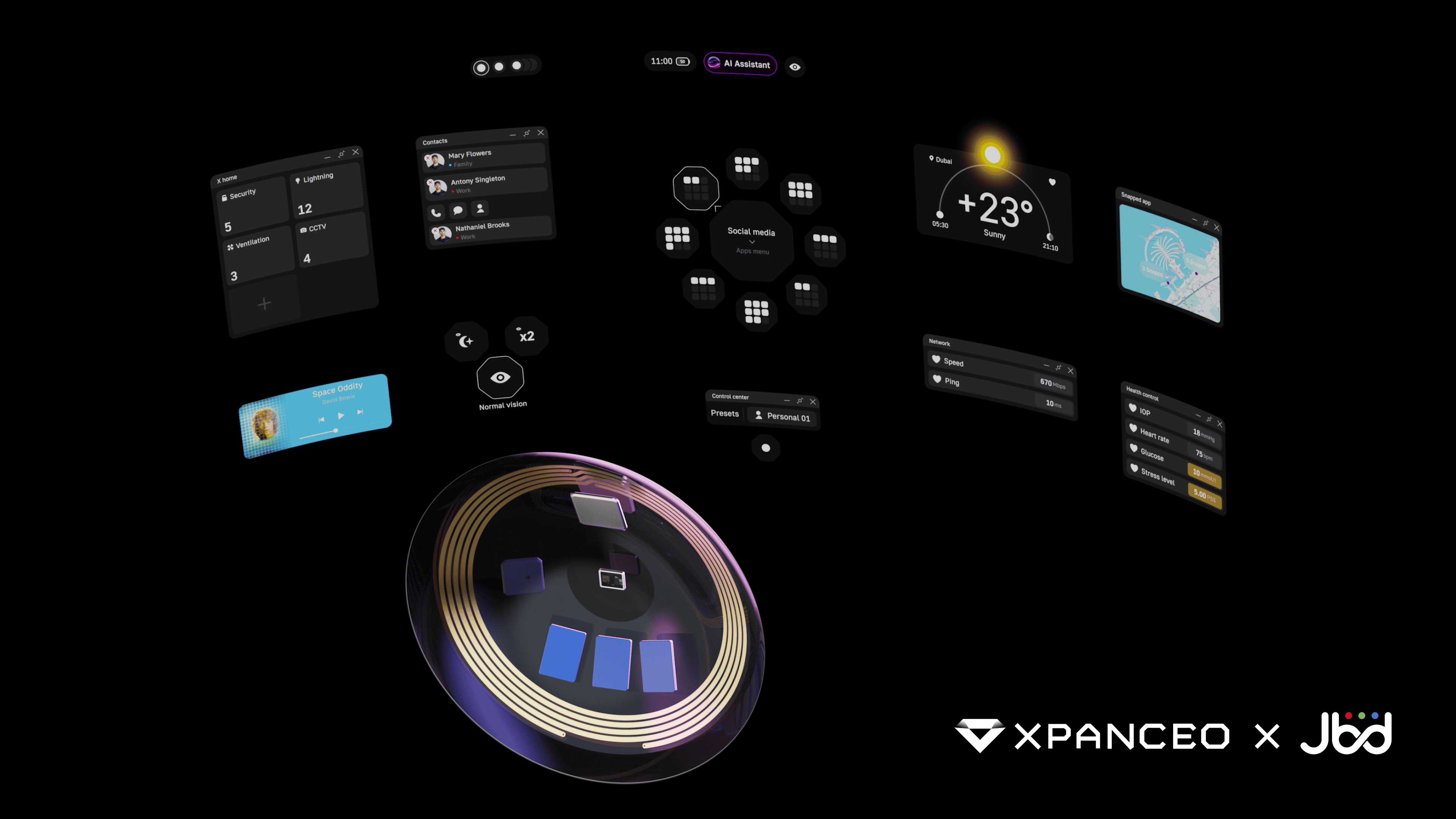
The project marks the second phase of this collaboration between these companies, building upon a series of successful milestones. During the proof-of-concept stage, the teams created a printed circuit board (PCB) with an integrated micro-display, connecting the screen to the lens processing unit. Another major breakthrough was the development of a unique optical system capable of forming a precise image upon which a human can comfortably focus despite being positioned extremely close to the surface of their eye. The XPANCEO team also demonstrated that such a system can be powered entirely by wireless means, thus removing the need for internal bulky components.
The two teams defined the precise technical criteria required to make the micro-display suited and comfortable specifically for a contact lens. Since such highly specialized form factors are rarely required by other industries, XPANCEO and JBD are engineering a novel technological solution tailored specifically for this application, addressing a unique gap in the current market. While conventional smart glasses can accommodate significantly larger components, the ones in smart contact lenses must be kept at around the thickness of a human hair to ensure comfort and wearability. The diameter of the resulting display is expected to be no more than a fraction of a millimeter.
Brightness management is another critical challenge in developing a micro-display positioned so close to the eye, as light levels must be carefully balanced to ensure ocular safety while remaining strong enough to see clearly and comfortably. Because images are projected directly onto the retina, an optimal balance can be achieved with significantly lower brightness than conventional AR wearables such as smart glasses. This reduced brightness requirement enables substantially lower power consumption, especially important given the extremely limited space available for energy storage inside a smart contact lens.
However, designing a display specifically optimized for ultra-low-power operation requires a fundamentally different architectural approach, particularly at the backplane level—the electronic circuitry responsible for driving the pixels. In conventional displays, backplane electronics are engineered to support the high electrical currents required for extremely bright LEDs, resulting in an inherently higher baseline power consumption. For smart contact lens applications, on the other hand, the custom backplane must be optimized strictly for minimal current operation. XPANCEO and JBD are therefore co-developing a specialized micro-display architecture designed to minimize unnecessary power loss and achieve exceptionally low power consumption.
Several companies in the industry have successfully demonstrated early-stage prototypes of microdisplays for smart contact lenses, the technology has yet to reach true commercial product readiness. The partnership between XPANCEO and JBD is specifically focused on scalability and manufacturability, aiming to establish the first mass-market production run of specialized contact lens microdisplays. This collaboration, together with XPANCEO’s previously announced partnership with ITEN for micro-batteries and the company’s expertise in advanced materials enabling the extreme miniaturization of optical elements, represents another important step toward commercialization. Founded in 2021 by Roman Axelrod and Valentyn S. Volkov, PhD, XPANCEO is driven by the mission to bring smart contact lenses to the market as the ultimate interface for the AI era. Collectively, these advancements are bringing consumer-ready smart contact lenses closer to reality than ever before.